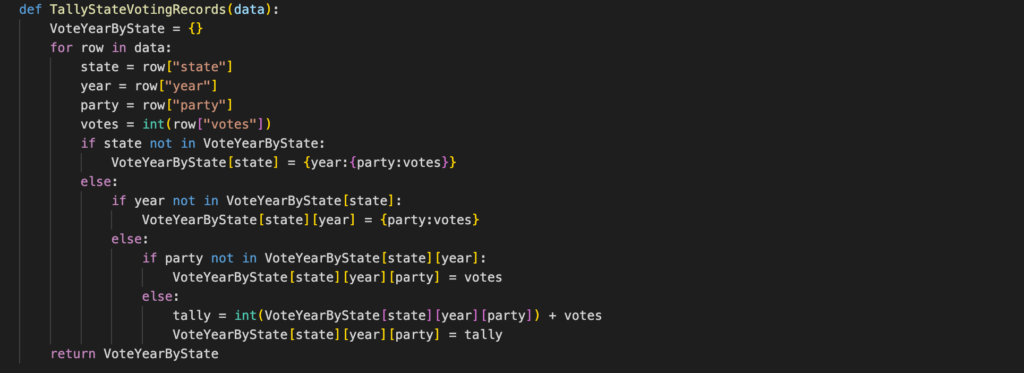
Learning coding shouldn’t be a requirement for humanities students, but that doesn’t mean it isn’t valuable to them. Ultimately the discussion between Kirschenbaum and Donahue can be traced to the greater discussion over the value of interdisciplinary studies. As someone who goes to a liberal arts school, I think having a diverse curriculum is important. Most people who gets a BA in a humanities subject will not need coding experience. But that doesn’t it mean it isn’t helpful to have a basic understanding of it. As Kirschenbaum states “an appreciation of how complex ideas can be imagined and expressed as a set of formal procedures — rules, models, algorithms — in the virtual space of a computer will be an essential element of a humanities education”
“an appreciation of how complex ideas can be imagined and expressed as a set of formal procedures — rules, models, algorithms — in the virtual space of a computer will be an essential element of a humanities education”
Kirschenbaum, Matthew. “Hello Worlds (Why Humanities Students Should Learn to Program).” Hello Worlds (Why Humanities Students Should Learn to Program), 26 May 2010.
During High school I worked in a research lab doing computational chemistry. The work I did that could be categorized as computer science or coding was limited. I learned to write a few batch scripts and how to navigate a linux terminal. I don’t think I really understood what I was doing and that made it difficult to communicate with my mentor. But last spring I had a bit of an epiphany when I took CS 110. While learning python is fundamentally different from the “coding” I did in high school, I think the general concepts are still applicable. Understanding how a computer reads instructions and the rules by which a computer operates is valuable and upon reflection would have helped me better communicate with my mentor.
The connection between STEM and CS is a lot more explicit than CS and the Humanities, but it is difficult to ignore the benefits of developing your computational literacy. We don’t work in a vacuum and while coding skills might not be necessary for everyone in the humanities, it can help you become a more collaborative and multifaceted person.
<!DOCTYPE html>
<html>
<body>

<h2>How does a computer process information?</h2>

<p> Functions are a simple way of defining reusable segments of code. This function requests two inputs x and y and adds them</p>

<p>Now when someone in CS tells you about functions and variables you'll be able   to understand what they are talking about:</p>

<p id="test"></p>

<script>
function example(x, y) {
  return x + y;
}
document.getElementById("test").innerHTML = example(1, 2);
</script>

</body>
</html>
the snippet of code above I wrote after taking a few tutorials on javascript and HTML from the website HTML Dog
2 thoughts on “Should Humanities Students Learn Coding?”
Comments are closed.
I totally agree that it makes sense for the coding to be in a way that is actually applicable and interesting to the person that is learning it. While learning the basics of coding is cool and is good for your brain, there are people that are dedicating their whole life to it. I think having liberal arts students learn these skills in a way that makes sense for them is the best outcome.
I feel the same way about the system crafted by liberal arts institutions. It helps students utilize any tool at their disposal as long as it is the best way to get work done. That freedom is what makes most of the fields of study interconnected. Humanities and CS are interlinked in that sense. That’s why it is advisable for a humanities student to learn to code if necessary for solving a particular problem in the humanities. But to say that it is a required skill (as the question suggests) for the humanities disregards the core principle of the field of study.