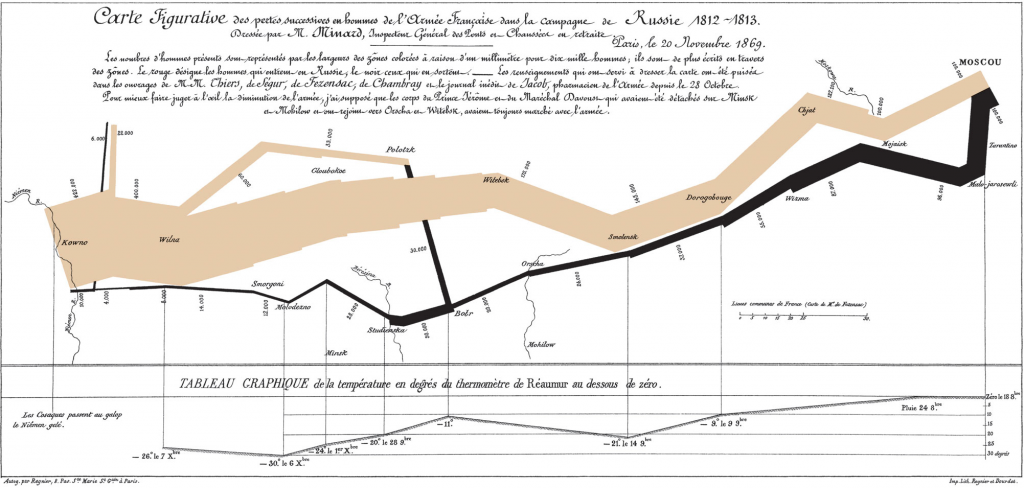
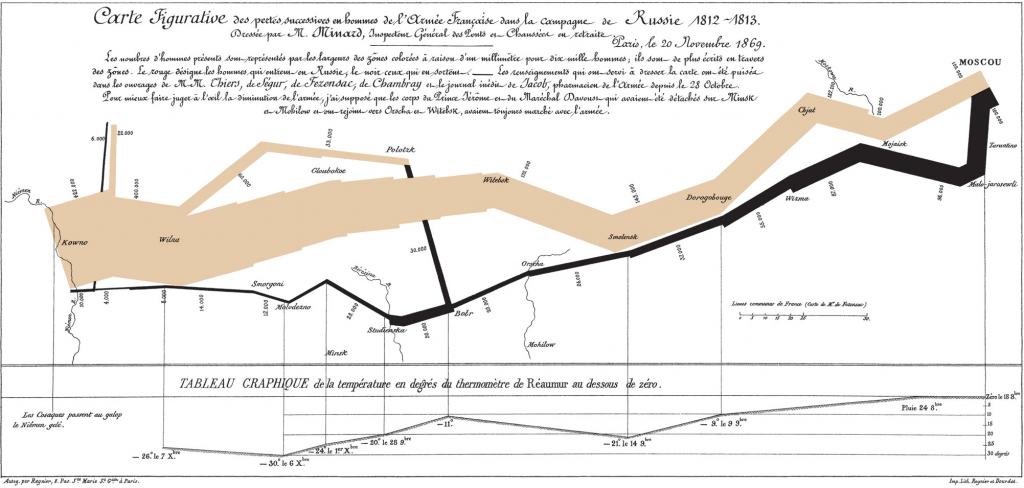
This picture, made by Charles Minard, depicts Napoleon’s campaign to force the Russians back further into their own country. The graph includes many types of data elegantly packed within the picture, including direction of travel, latitude and longitude, size of Napoleon’s troops, and geographical location at specific times. It was a definitive infographic in its time due to the features mentioned above, and utilizes data in an elegant way to represent the events that took place in Russia. I don’t know if I agree with it holding the title of “best ever”, as I am sure there are better diagrams out there, but it is definitely the greatest one that I have come across in my research.
If I were to improve it, I would add a clearly marked elevation profile to provide context to the type of terrain the troops encountered. This would help readers understand the travel more clearly and hopefully clarify the hardships of travel. I might add a feature which makes the map animated and marks violent encounters to give more context, with the line progressing and shrinking while the temperature and elevation profiles follow it throughout the trek.
The interactive version with the slider was very fun to play around with, but I think I would have liked it more if it showed both legs of the campaign rather than just the retreat. The slider proved useful to visualize the temperature and man count change over the course of the retreat, though. I could not load the other interactive version because it kept timing out, but from the pictures of the developer’s discussion, it also looks quite easy to use, and has a nice graph to visualize the troop’s size over time.
1 thought on “Reflecting on Data Visualization”
Comments are closed.
From reading your description and using the interactive version of Charles Minard’s infographic, I attest to the fact it is one of the best infographics I have come across. I like the animation feature you suggested because I have been wondering why there was a sudden decrease or increase in the population of Napoleon’s men at some times throughout the journey. Adding such a function might answer this question.