This week we were tasked with looking at a network analysis Digital Humanities project. I decided to look at the Homestead Nebraska project, created by some researchers looking at how Homesteading in the American West was an important process in the forming of farms. These researchers used homesteading data and networking to help study how homesteading shaped the American West.

Let’s looks a bit at the network that these researchers decided to build:
What are the nodes? What are the edges?
Homesteading was a process where individuals could make a claim to land and then be verified by other homesteaders that they did indeed lay claim to certain land. Hence the edges (or connections) were these testimonies that individuals gave for each other. The website defines them as “socio-legal” connections. Thus our nodes are the individuals who are homesteading. This includes both those that are making a claim to land and those who are supporting their claim.

What sort of interactions does this project allow?
This project allows you to look at small collections of different networks, grouped by geography. Instead of this being one massive network, it has many networks that are not interconnected. It also has options to look at these networks by community, leaders, or geography. The project is deeply interactive, but hard to pull together data as a casual observer flipping through tabs.
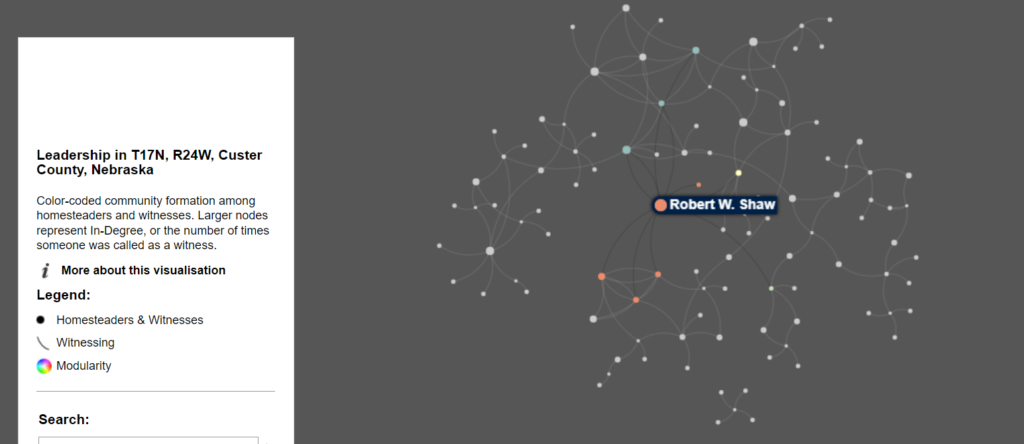
Above is an example of a specific network from the homesteading data. I appreciated the color coding and highlighted connections. I did find it a bit hard to really get much out of the data since there were so many networks and so many possible people. I think as a whole these networks can do a lot for research, but aren’t super great for casual viewing such as what I was doing for this project.
3 thoughts on “Blog 3: Networks in Nebraska”
Comments are closed.
This network seems pretty unique, since I don’t normally think of networks being discrete entities. This sort of seems like a bunch of mini networks. I also think it’s cool that you mentioned it could be laid out geographically. Does this mean that the nodes are arranged in the distance each homestead was to each other?
I agree with Sonya about the uniqueness of this project’s network being separate entities – seems a little counter to the features of networks that we talked about in class and read about. If this project is focused on the relationships between homesteaders in Nebraska I wonder if this could be expanded out to see if there were connections extending across the West.
This is a really interesting project. Do you think it could be applied to other forms of historical social networks? Also I never knew that homesteaders hand to verify each other for their claims to the land so this was really interesting to read about.