
This network graph Six Degrees Of Francis Bacon shows the social network of Francis Bacon, the English philosopher and statesman. The nodes are all people within his social network and the lines between them, or edges, are the connections between those people. Each “degree” represents the edges. For example, there is one edge between Frances Howard and Francis Bacon meaning they knew each other so they are one degree apart. The size and color of the nodes represent the degrees from Francis Bacon; the larger and darker the node, the closer the person is to a connection with him.
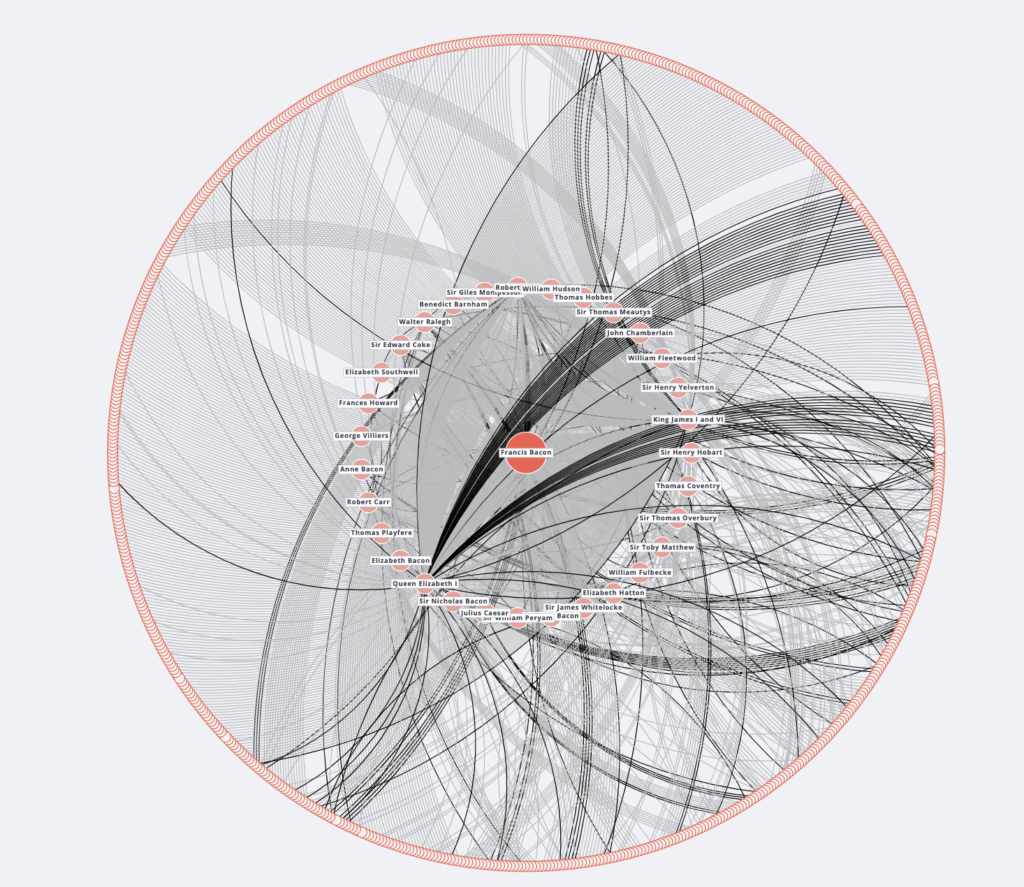
Something I liked in this network graph is the option to choose between Hooke and concentric visual layouts. I thought both options served a different purpose in analyzing the networks. The Hooke view allowed there to be different groups forming showing which people were closer to each other not just Francis Bacon. Each social circle forms through the connections of the scholars and nobility of the time. The concentric view, on the other hand, is centered around Francis Bacon and makes it easy to analyze what degree each person is at from the origin as each concentric circle represents a degree.
The creators of this network graph are Christopher Warren, Daniel Shore, Jessica Otis, Scott Weingart, and John Ladd. All of them are researchers or professors at Carnegie Mellon or Georgetown University. This allows them to have access to host their site with Carnegie Mellon University Libraries. They mention that the entire site is coded using Angular, Ruby on Rails, and D3 which is shown in their Github repo. They also have another repo specifically for the network interface. The interface is coded mostly in R and they referenced the Oxford Dictionary of National Biography for the R scripts they based their code on. It seems that to get the graph, they first had to do text processing of the data which separated and organized it before converting them into matrices for network estimations. It is quite interesting how they were able to use existing code and material and convert it to fit their needs. That seems to be a common theme in Digital Humanities projects as collaboration is a pillar of the field. This project in particular has room for expansion as it is open to more collaborators to edit so I would love to see where others that join the project would take it in the future.
4 thoughts on “Six Degrees of Francis Bacon Network Graph”
Comments are closed.
I agree that it is interesting/surprising that they were able to use the existing materials (in text form) to create this visualization. I do wonder how much accuracy this takes away from the data though, as looking into large bodies of text like we discussed in class can be vague and inaccurate.
I was a bit intimidated by the sheer amount of data in this project when I first looked at it, but I agree that having the option to switch between the Hooke view and the concentric view was helpful in figuring out more of what the data had to offer. Your point about the authors being able to make existing analyses and data work for their project was also something I hadn’t paid much attention to thus far, but I’d like to be more mindful of in the future due to its importance.
I like your detailed analysis of how the project is written and attaching links to the git repo, which is helpful for people who hope to explore further. Github is a good resource for reusing other people’s code, and I agree that it is a good practice for digital humanities. The two different views are also interesting. Even with the same set of data, different visualizations would offer different emphasis on information.
I appreciate you noting the creators who built the project and the technologies they used. With the understanding that it can be a drag to learn web technologies, I’m thoroughly impressed with the fact the creators were primarily humanists. Whatever the answer may be to the ‘Should Humanists Learn to Code’ debate, one cannot deny the amazing output that has come from humanists learning to code. Does that debate even matter maybe as long as we can respect the labor and beauty of digital humanities projects?