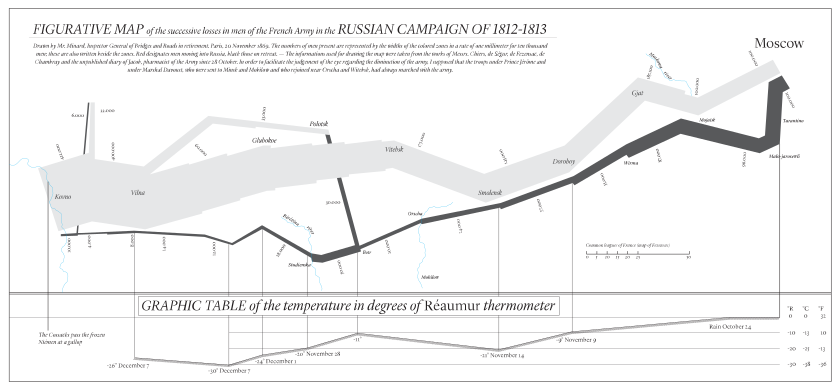
Pictured above is Charles Joseph Minard’s Map depicting the travel and subsequent retreat of Napoleon’s troops during his march to Russia in 1812. It is considered one of the best-ever data visualizations because of its multivariate complexity, or its ability to include a great amount of distinct information such as the change in troop size, migration direction, temperatures, etc.
I understand the hype behind this map. It’s one of the first ever to include so much information, so succinctly and without cluttering. It’s relatively aesthetically pleasing because it is one of the first graphs I can say was blatantly easy on the eyes. The colors are well contrasted, the lines thick, and the text legible so there’s no confusion when it comes to the individual components. Where I deviate from Edward Tufte, Minard’s #1 fan, is in saying that this is not the best graph ever.
When I first looked at the visuals and the description, I could tell what it was trying to show. However, there was no clear starting point and the only possible indication of where to begin was the giant “Moscow” in the top right corner. Upon closer inspection, one can see at the far left that the first river is pointed at and labeled “The Cossacks pass the frozen Niemen at a gallop”, but the text is all the way down, near the temperature graph. At a minimum, this label should be more blatant about being the starting point. And yes, anyone that knows some geography could have the idea that the far west is the starting point, but, as we learned during our discussion with Lin, the data presented should be guiding the viewer’s eyes. There is so much information here that a layperson would take more time than is necessary to know even what direction to read this in.
2 thoughts on “DATA VISUALIZATION BLOG”
Comments are closed.
I am very much in the camp of less is more when it comes to data visualisation, particularly graphs. While it is important to get all of the necessary information across, the more you are trying to throw at the graph interpreter, the less attention they can devote to the main point that you are trying to make. I think in most cases more succinct graphs is the better choice versus one giant overloaded data visualisation.
I disagree with your point that one would start reading from Moscow, the lines flow toward Moscow, which gives a sense that the soldiers were marching there. What is more, I believe the majority of western audiences would instinctively read the map from left to right. Do you think if the author had outlined the name of the starting place just like he outlined Moscow the map would be clearer?