Attempting to model an object is hard. You have to get as many photos as possible, but can only upload 100 for AutodeskReCapPhoto to use. You should shoot pictures of the object from any angle, but getting your shadow in any of those shots will ruin it. You can take photos with your camera or your phone, but they can’t be blurry. Because of all of these perimeters, one is forced to view the object they are meant to be modeling in a more mindful way: where are there holes and shadows? What is the detailing on the top and sides? When modeling an object you can’t simply look at it for a few minutes, read the description card, then move on to the next object in the museum. You have to look closely at every detail or else the model won’t turn out.

We were told by Teresa Lenzen, the technical director of the museum, that the tower was likely a sculpture of an outhouse, and that the pig or boar was likely connected to it to recycle the waste from the former. This made me curious about the connections between human and environment and how one could return to a symbiotic relationships within the two. Was this type of structure common place in society at the time? Was it mostly used by the rich? Farmers? Closely engaging with the “small tower” raised many questions and the need to further research the topic for me.
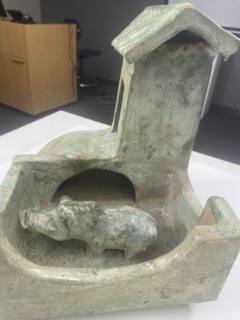
I think that this engagement connects us to our past and histories. By creating 3D models, we have to think critically not just about creating the perfect digital replica but also why and how the object was made. By looking at The Smithsonian’s 3D model catalogue, I also thought about democratization. Who gets to see museum objects? Sure, many museums are free to enter, but are they accesible for disabled people/people with disabilities? Are they affordable to travel to? While not everyone has access to viewing devices, many do. And if everyone can look closely at and manipulate objects, we’ll all be more connected in our histories and pasts.
